

The Wholesale Electricity Market
Spot prices in the wholesale electricity market increased in February from the extreme lows of December and January. Average spot prices for the month ranged from $38 in the lower South Island (up from $2 in January), up to $51 in the upper North Island ($4 in January).

The following chart shows average weekly spot prices over the last 2 years. The extreme low prices in the last few months can be clearly seen, as well as the recent increases.

Electricity Demand
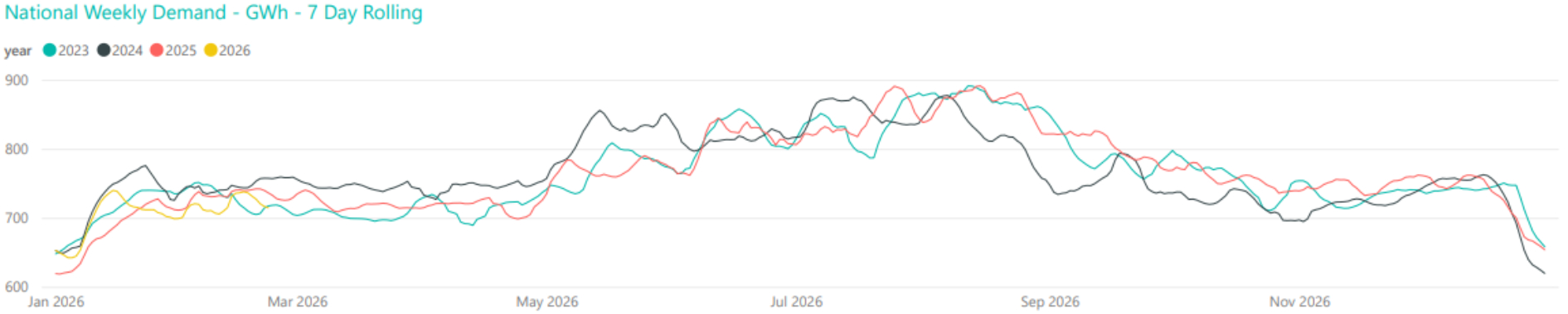
Demand in February remained at or below the level expected for this time of year as shown below.
Electricity Generation Mix
Low demand and continued strong hydro, geothermal and wind generation meant that thermal generation remained at the minimal levels that have been seen now for several months.

HVDC Transfer
Power transfers on the HVDC link connecting the North and South Islands are important both in showing relative hydro positions and the reliance on thermal power to meet demand. High northward flow tends to indicate a good SI hydro position, whereas the reverse indicates a heavy reliance on thermal power to make up for hydro shortages.
Northward transfer in February remained strong, though high NI inflows meant it reduced later in the month. Again, southward transfer was nearly non-existent.

The Electricity Futures Market
The Futures Market provides an indication of where market participants see the spot market moving in the future. They are based on actual trades between participants looking to hedge their positions (as both buyers and sellers) into the future against potential spot market volatility. They are also a useful proxy for the direction of retail contracts.
The following graph shows Futures pricing for CY 2025, 2026, 2027, 2028 and 2029 at Otahuhu (Auckland) for the last 5 years.
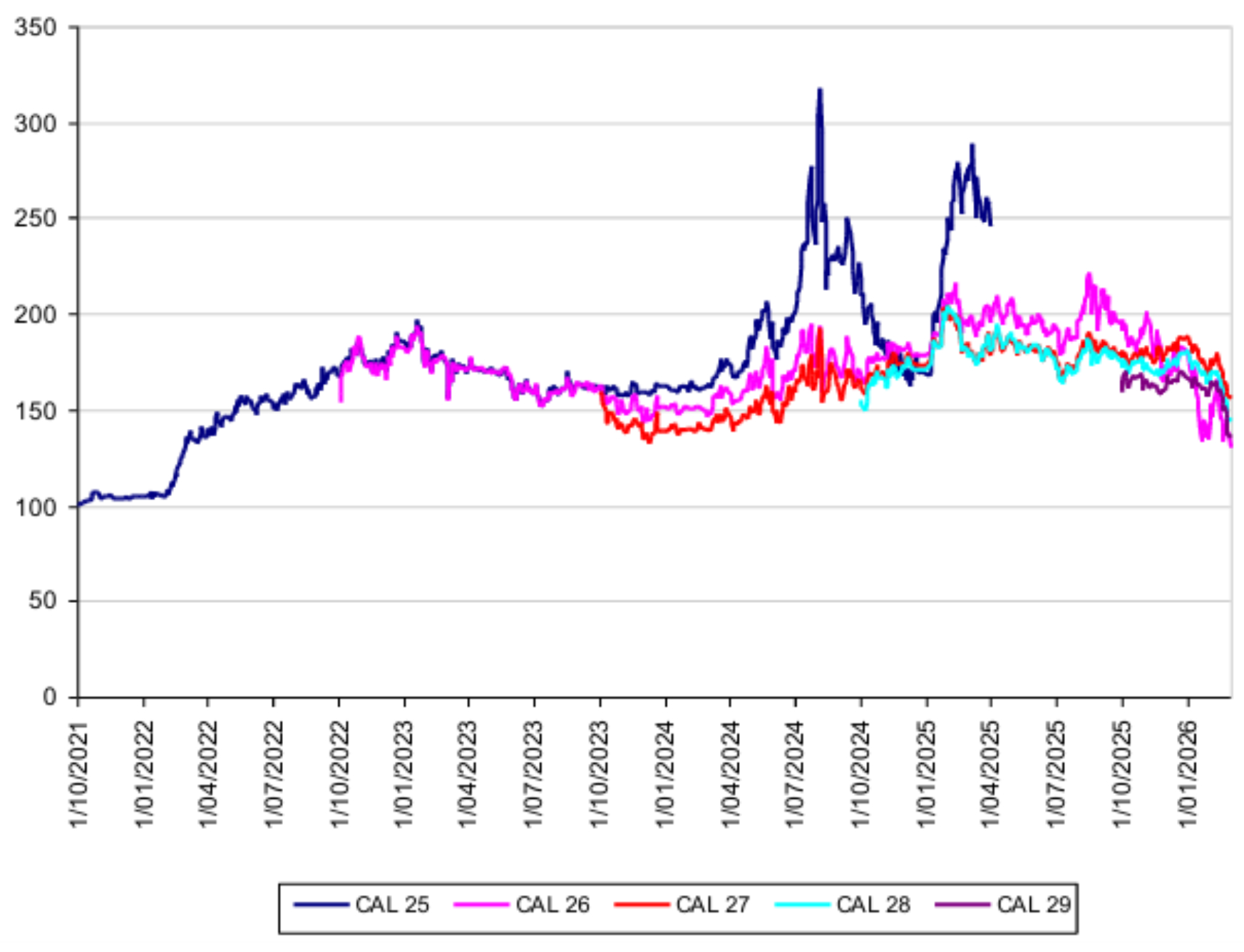
Note that $200/MWh equates to 20c/kWh.
Forward prices were down for all years through February. CAL 2026 decreased ending the month at $130/MWh – down 10%. CY 2027 price was down 9% at $156 while CY 2028 was down 13% at $145. CY2029 was down 16% at $136.
Known new generation projects are shown below (additions / removals / changes highlighted in bold).

Hydro Storage
Inflows remained above average in the North Island but dropped to below average in the South, as shown below.

The lower inflows, combined with high hydro generation, resulted in storage falling through February. Energy storage levels decreased 196GWh through the month to end at 4,013GWh (91% full). Storage remains above the average level seen at this time of year. The following chart shows the latest breakdown of storage across the main hydro catchments.

Security of supply risks remained low in February with storage levels well above average levels as shown below.

Snowpack
Snowpack is an important way that hydro energy is stored over the winter months and released as hydro inflows in the spring. The following graph shows that the snowpack in the important Waitaki catchment decreased during February but remains close to the 75th percentile level seen in the last 30 years for this time of year.

Climate outlook overview September - November 2025 (from NIWA)
- The coupled ocean-atmosphere system transitioned to ENSO-neutral (El Niño – Southern Oscillation) during February (i.e. neither La Niña nor El Niño). However, some remnant La Niña like circulations are expected to linger over the next few months, which may contribute to rain-bearing systems coming from the north.
- The Relative Oceanic Niño Index weakened (became less negative) in February 2026. With a value of –0.67°C, it no longer meets the La Niña threshold of –0.7 °C.
- Subsurface temperature anomalies now show a clear departure from previous La Niña‑like patterns.
- A sharp increase in Sea Surface Temperatures (SSTs) along the South American coast signalled the development of a so-called ‘coastal El Niño’, expected to be short-lived.
- There is a 95% chance for ENSO-neutral conditions to remain in the Tropical Pacific over the forecast period (March – May 2026).
- Despite the seasonal predictability barrier, the development of El Niño by winter is looking increasingly likely.
- For the next three-month period, the atmospheric circulation pattern over New Zealand is expected to see anomalous high pressure to the south of the country, and anomalous low pressure just to the north, leading to an easterly quarter flow anomaly overall.
- While autumn begins on an anticyclonic note, the risk of tropical incursions resumes from the second week of March, with unsettled conditions for the country. Although high pressure will most likely follow behind this and bring settled conditions, there is potential for another northerly sourced rainmaker near the end of the month, or in early April.
- For the remainder of April, and for May, the most likely source of significant weather is still to our north. Southern Ocean systems may be reduced in frequency, and the South Island in particular could see some prolonged settled periods.
- The Tropical Cyclone Outlook for the November 2025 – April 2026 southwest Pacific Tropical Cyclone (TC) season indicates a normal or elevated risk for ex-TC interaction for New Zealand. Although the season has been quiet so far, we remain in the peak climatological risk period for part of the outlook period, and there are indications of increased tropical activity over the next month compared with earlier in the season.
- Seasonal air temperatures for March – May 2026 are most likely to be above average for the north and west of the North Island, near average for the east of the North Island and the north and east of the South Island, and near or above average for the west of the South Island.
- Rainfall totals for March–May are most likely to be above normal in the north and east of the North Island. Near normal or above normal rainfall is forecast for the west of the North Island and east of the South Island, while near normal rainfall is expected in the north of the South Island. Below normal rainfall is most likely for the west of the South Island. There is an elevated risk of tropical‑influenced weather systems bringing significant rainfall to parts of the North Island, especially at intervals in March and April.
- During March – May 2026, near normal soil moisture levels and river flows are expected for the west of the North Island and the east of the South Island. Near or below normal soil moisture levels and river flows are forecast for the north of the North Island and the north of the South Island, while near or above normal soil moisture levels and river flows are forecast for the east of the North Island. In the west of the South Island, near normal soil moisture levels are most likely, while near or below normal river flows are equally likely.

The Wholesale Gas Market
Spot gas prices increased through February. Prices for the month averaged $9.6/GJ – a 27% increase compared to January. Average prices are 40% below what they were at the same time last year. Note that spot gas prices include the cost of carbon (currently around $2/GJ)

On the supply side most fields maintained output through February. Turangi and Kowhai again bucked the trend increasing output to average 55TJ/day. McKee / Mangahewa maintained about 73-5TJ/day apart from a short 4-day outage in the middle of the month. Pohokura maintained output at 30TJ/day as did Maui at about 37TJ/day. Kupe also held output at 34TJ/day apart from a week shutdown in the middle of the month.
The following graph shows production levels from major fields over the last 7 years.

Huntly maintained low gas usage to start February but increased from the middle of the month to around 36TJ/day. Methanex started the month using more than 90TJ/day but reduced to just over 60TJ/day from the 11th Feb for the rest of the month.
The following graph shows trends in the major gas users over the last 7 years.

Gas storage is becoming increasingly important as falling production coincides with more variable demand particularly from gas fired electricity generation. The following chart shows how storage at Ahuroa maintained the same high level seen in January. It is above the maximum levels seen at this time of year over the last few years.

Internationally, LNG netback prices were $13.5/GJ – up 12.5% from last month. Forecast prices were down 3% at $13.22/GJ for 2026 and $11.89/GJ, down 3% for 2027. (Note that netback prices are indicative of international prices – they are produced by the ACCC and quoted in Australian dollars. They are net of the estimated costs to convert from pipeline gas in Australia to LNG, hence the term “netback”)

New Zealand does not (yet) have an LNG export/import market, so our domestic prices are not directly linked to global prices, though this may change with the Government announcing that an LNG import terminal will be built in the next few years.
LPG is an important fuel for many large energy users, particularly in areas where reticulated natural gas is not available. The contract price of LPG is typically set by international benchmarks such as the Saudi Aramco LPG – normally quoted in US$ per metric tonne.
The following graph shows the Saudi Aramco LPG pricing for the last 5 years as well as forecast pricing for the year ahead. Futures pricing were up slightly over the last month.

The other main contributing factor to LPG prices in New Zealand is the exchange rate against the USD. The exchange rate was around 0.6 at the start of the month, 0.595 from the middle of the month. This is near the average levels seen in recent years. The recent increases would tend to push down LPG prices when quoted in NZD.

The Coal Market
The global energy crisis has been as much about coal as it has gas. The war in the Ukraine has driven energy prices, including coal, up. Prices in February increased, ending the month at $119/tonne – up 2.5%. These prices are finally returning to levels close to what we expect to see as shown in the following graph of prices over the last 10 years.

Like gas, the price of coal can flow through and have an impact on the electricity market. In February Genesis reported the coal stockpile at Huntly was at about 1.2 million tonnes of coal, sufficient to produce about 2380 gigawatt-hours of electricity from the Rankine generators.
Carbon Pricing
NZ has had an Emissions Trading Scheme (ETS) in place since 2008. It has been subsequently reviewed by several governments and is now an “uncapped” price scheme closely linked to international schemes. However, there are “upper and lower guard-rails” set up to prevent wild swings in carbon price that act as minimum and maximum prices. These increased in December 2023 to $173 and $64 respectively. Carbon prices were unchanged in February at $34.

As the carbon price rises, the cost of coal, gas or other fossil fuels used in process heat applications will naturally also rise. Electricity prices are also affected by a rising carbon price. Electricity prices are set by the marginal producing unit – in NZ this is currently typically coal or gas or hydro generators, with the latter valuing the cost of its water against the former. An increase in carbon price can lead to an increase in electricity prices in the short to medium term (as the marginal units set the price). A carbon price of $50/t is estimated to currently add about $25/MWh (or ~2.5c/kWh) to electricity prices. In the long term the impact should reduce as money is invested in more low-cost renewables and there is less reliance on gas and coal fired generation.
EU Carbon units decreased in February to 78.4 Euro/tonne. Australian Carbon Units were unchanged at AUD$37.6
About this Report:
This energy market summary report provides information on wholesale price trends within the NZ Electricity Market. Please note that all electricity prices are presented as a $ per MWh price and all carbon prices as a $ per unit price. All spot prices are published by the Electricity Authority. Futures contract prices are sourced from ASX.
Further information can be found at the locations noted below.
- Transpower publishes a range of detailed information, which can be found here: https://www.transpower.co.nz/power-system-live-data
- The Electricity Authority publishes a range of detailed information, which can be found here: https://www.emi.ea.govt.nz/
- Weather and Climate data – The MetService publishes a range of weather-related information, which can be found here: https://www.metservice.com/
Disclaimer: This document has been prepared for informational and explanatory purposes only and is not intended to be relied upon by any person. This document does not form part of any existing or future contract or agreement between us. We make no representation, assurance, or guarantee as to the accuracy of the information provided. To the maximum extent permitted by law, none of Smart Power Ltd, its related companies, directors, employees or agents accepts any liability for any loss arising from the use of this document or its contents or otherwise arising out of or in connection with it. You must not provide this document or any information contained in it to any third party without our prior consent.
About Smart Power:
Smart Power is a full-service Energy Management consultancy. Apart from Energy Procurement, Smart Power can also provide:
- Technical advice on how to reduce your energy use & emissions
- Sustainability Reporting
- Invoice Management Services
We also offer boutique energy and water billing services for landlords/property developers.
Contact us here or call one of our offices to talk to our experienced staff about how we can assist you with achieving your energy goals.
© Copyright, 2026. Smart Power Ltd


